

Hey there, history buffs!
I have an announcement for you.
History has fascinated me since childhood. But when I started blogging a decade ago, it was all about food.
I wrote about how the humble Schnitzel inspired Calcutta's iconic crumbed fish fry, the time I met chef Sean Brock in a Toronto takeaway where he was whipping up his signature cheeseburgers and hot chicken, and the experimental recipes I tried in my tiny kitchen.
Back then, I was a die-hard Anthony Bourdain fan(I still am). I found his style of weaving travel and food into unforgettable stories appealing. I would binge on No Reservations and Parts Unknown whenever I could.
Fast-forward: Over the years, I traveled less, ate out even less, and my cooking was more functional to serve my nutritional needs.
But one thing never changed: my curiosity about what people ate in the past.
Where did our favorite dishes come from? How did trade routes and migrations shape the way we eat? And just how similar are our meals to those of our ancestors?
That’s why I’m thrilled to introduce a new section to my Substack: Grubstoria.
Here, we’ll explore the fascinating stories behind the food we love and how it evolved, traveled, and connected us across time and cultures.
I’ve unlocked a few archive posts exploring ancient recipes, prehistoric diets, and unusual food experiments to give you a taste.
Recreating a 1500-Year-Old Burger

Have you ever wondered what a hamburger might have tasted over a thousand years ago? Was it a juicy treat with melted cheese on a mushy bun like today? While we debate the origin of the burger, most food historians associate it with the Hamburger steak, a minced meat steak famous in Hamburg, Germany.
Neanderthals Were Not Always Meat Eaters, According to Their Teeth

When we think of Neanderthals, we imagine strong human-like creatures who hunted gigantic beasts such as the woolly mammoth. They were hardy and intelligent enough to hunt animals much larger than them. Recent research reveals that the diet of the Neanderthals was diverse. This is contrary to the popular perception of them being only meat-eaters.

Grubstoria's focus is slightly different from that of the primary newsletter.
As food continues to be an important part of our lives, many recent developments have shaped what we eat. Hence, the timeline of the Upper Paleolithic to the collapse of the Mongol Empire won’t apply to this section.
There will be stories from Medieval and Modern times, though I’ll try to maximize the focus on ancient times.
In Forgotten Footprints, I highlight stories from lesser-known cultures, civilizations, and empires. However, in Grubstoria, we’ll also discuss food from popular cultures. This is because food has seldom been the focus of historians. Much of what we know is a mix of myths, legends, and oral history. Also, there are minimal records beyond what the royals ate; hence, even if it's a well-known civilization, there’s still much to explore about its gastronomy.
That said, I’d understand if food is not your thing. You may have signed up to learn about civilizations not covered in textbooks and popular discussions. Don’t worry if the topic doesn’t interest you; all you have to do is turn off this section's alerts.
Here’s how:
Step 1: Log into Substack from your laptop or desktop web browser (please note that this can’t be done from the app or mobile web browser).
Then, go to the “newsletters” tab of Forgotten Footprints.
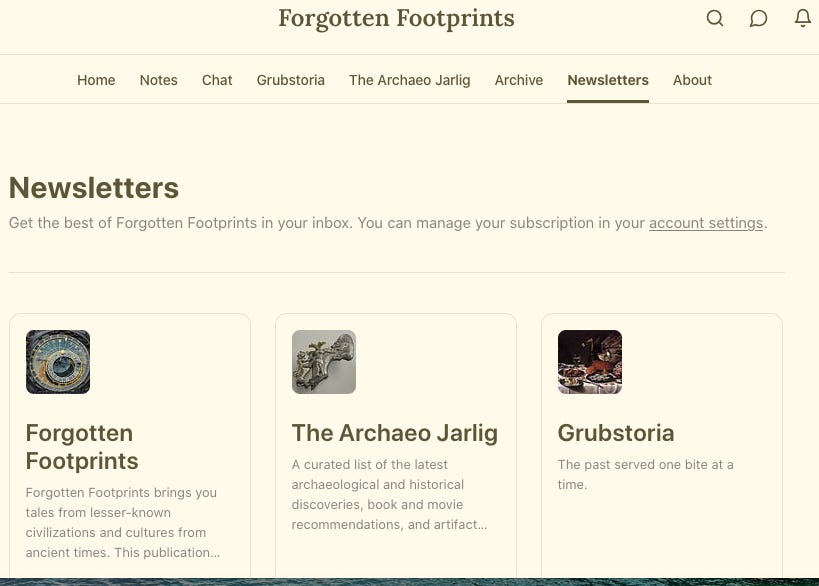
Step 2: Click on account settings and toggle the notifications you’d like to receive.
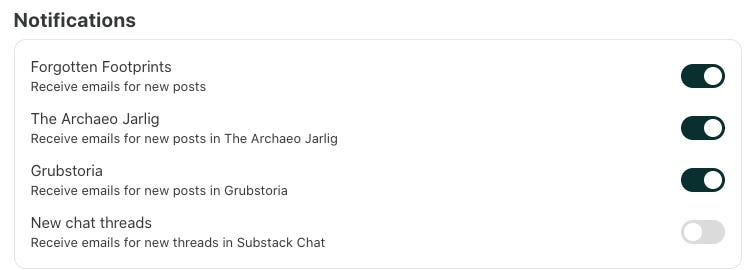
You may have noticed another section called “Archaeo Jarlig,” formerly “The Weekly Jarlig.”
I’ll be scaling back a bit from providing weekly updates on archaeological and historical finds and returning to the older format of making it a monthly edition. This allows me to focus more on Grubstoria and the primary newsletter.
Forgotten Footprints and its core topics will remain the same. This is an additional offering for those interested in how food has shaped our history and continues to affect us.
An appeal
I started Forgotten Footprints with a mission to highlight stories from the past that don’t receive much attention.
Since offering paid content from the end of last year, many of you chose to upgrade your membership, which helps me focus on researching, buying books, and learning about the history of people who didn’t leave behind written records.
If a few more of you opted for paid membership, it would help me devote more time to making Forgotten Footprints an authoritative guide to the past. You’ll receive exclusive paid content such as The Mystery of Cahokia’s Mounds: America’s Lost Ancient City, The Ice Age Mammoth Hunters Who Invented Ceramics, Who Were the Enigmatic Sea Peoples?, all the archived posts, and early access to some of the newsletter’s special editions.
At just $5 a month ($50 annually), your support ensures that the voices ignored by history textbooks are heard. So, if you can afford it, please support this work.
I am grateful to those of you who have opted for paid membership, and your patronage means a lot to me.
A special shout out to those who have recommended Forgotten Footprints in your Substack and regularly restack, like, and share it on your timelines. Thank you for helping me build a community of history enthusiasts who love learning about less-discussed topics from the past and ensuring more people discover my work.
I’m also counting on your support for Grubstoria! Together, we can keep these stories alive for future generations.
Thank you for being part of this journey.
Until next time, keep exploring the past with curiosity and ethusiasm.
I relish the idea of Grubstoria! You have whet my appetite! Looking forward to savoring the contents to see what you cook up!
Love this!
How did the ancient Romans feed their armies? Why did the tradition of feasting begin? When was the potato chip invented? Explore when foods were first cultivated, from prehistory to present day:
https://thesecretingredient.substack.com/p/when-did-your-favorite-foods-originate