
Did the Mongol Invasions Trigger a Little Ice Age?
Debunking the “Chinggis Khan the Green” theory

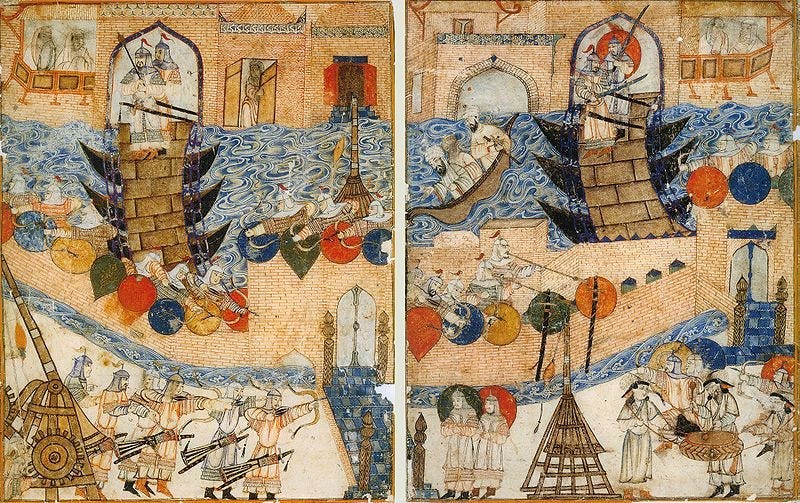

The idea that our planet cooled because of the Mongol invasions has been a hot topic of discussion for more than a decade. Chinggis Khan was dubbed “the Green Conqueror” because he slaughtered so many people that total carbon emissions fell, lowering the earth’s temperature.
Some have even claimed Mongol conquests caused the Little Ice Age in the 14th century. This isn’t just some random conspiracy theory. There is some science behind the claim.
Julia Pongratz and her colleagues published an article in the journal Holocene in 2011 that examined the effects of epidemics and wars on global carbon dioxide emissions between 850 and 1850.
She discovered that the Mongol Invasions, which killed 40 million people, significantly cut world carbon dioxide emissions. Though the Black Death killed 75 million people in a shorter period, the researchers concluded the Mongol conquests were the primary cause of global cooling.
The Daily Mail popularized Pongratz’s research with their famously titled tabloid “Genghis Khan the Green.” The Guardian also published her findings, sparking a debate on the subject.
The study received much more attention after being mentioned on the Joe Rogan Experience podcast. We won’t examine the science behind the claims. Closer historical inspection, however, debunks the idea that the Mongol invasions lowered global temperatures. The researchers have made several broad assumptions with little basis in events that occurred.
Reminder: By choosing a paid membership (just $5 a month or $50 annually), you're helping amplify voices that history books too often overlook. Your support means these stories get the attention they deserve.
You’ll gain access to tons of members-only content👇
Full-length deep dives into untold stories: no paywalls, no cuts.
The entire archive of amazing stories from the Ice Age to the Fall of the Mongol Empire, the hottest archaeological finds, and the appetizing history of food.
Early access to special editions—be the first to dive in.
Join lively discussions in members-only posts and subscriber chats.
Carbon Emissions and the Mongol Conquests
Let’s review the claims made by Pongratz and her colleagues.
The table below shows that Mongol invasions from 1200 to 1380 had a significant impact on carbon emissions.
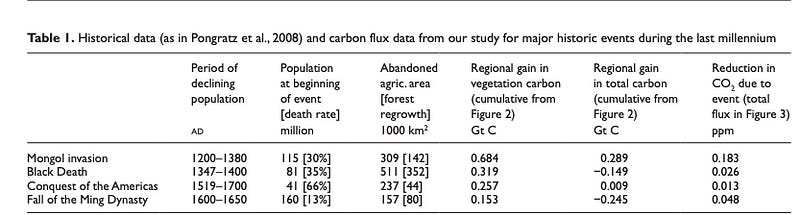
The Mongol invasions killed 40 million people. Although the numbers are significantly lower than those of the Black Death (75 million people), the impact was greater, as there was sufficient time for forest recovery. As a result, trees could absorb carbon dioxide.
Human depopulation and forest regeneration absorbed 700 million tonnes of carbon.
As the agricultural areas were abandoned and forests expanded, the planet cooled, triggering a Little Ice Age.
The Black Death and the fall of the Ming dynasty occurred during a period that was too short to significantly impact the Earth’s temperature and carbon emissions.
Pongratz’s reasoning makes logical sense. Fewer humans should cause lower emissions. Reduced cultivable land and woodland regeneration would help cool the planet.
However, her argument has major historical flaws. Let’s start with the most glaring one: the timeline of the Mongol invasions, which is the foundation of her study.
A Case of Good Science Bad History
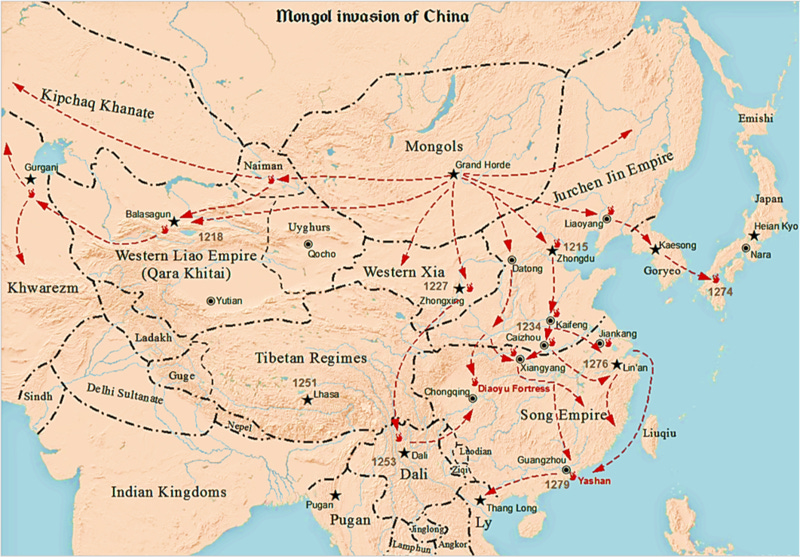
Pongratz dates Mongol invasions from 1200 to 1380, 180 years.
Temujin was elected Khan of the Mongols after unifying the tribes of Inner Asia in 1206, taking the title Chinggis Khan (Genghis Khan). In 1209, the Mongol invasions began with a campaign against the Xi Xia (also known as the Tangut Kingdom). The Tanguts were a Sino-Tibetan people who ruled northern China, northern Tibet, and southern Mongolia.
There were no “Mongol invasions” before 1209.
I’m puzzled as to why Pongratz chose 1200 as the start of the Mongol invasions, before anyone known as Chinggis Khan existed.
Her proposed end date for the Mongol “Invasions” is 1380.
After the death of Mönkhe Khan in 1260, the last great Khan of the united Mongols, the Mongol Empire, was partitioned.
Khubilai Khan, the founder of the Yuan dynasty, governed China, parts of Southeast Asia, Tibet, and Mongolia.
Batu Khan and his descendants governed much of modern-day Russia, the Caucasus, and Western Siberia. Historians call this territory the Golden Horde.
Hulagu Khan and his successors ruled over Persia and the Middle East. We call this region the Ilkhante.
The Chagatai Khanate ruled over a vast region of Central Asia, spanning from what is now Xinjiang and northern Afghanistan to Transoxiana (modern-day Uzbekistan).
The Yuan Dynasty lasted until 1368, the Ilkhante until 1335, and the Chagatai Khanate until 1363.
Apart from a battle at Kulikovo between Moscow (headed by Prince Dmitry Donskoi) and Mamai (the kingmaker of the Golden Horde), the year 1380 is largely ignored in the history of the Mongol Empire. To Russian nationalists, this battle symbolizes the “end of the Tartar yoke.” But the Horde was far from finished. Following the Kulikovo, the Khans of the Golden Horde sacked Moscow multiple times.
The Horde wouldn’t fall until 1502.
What is the reasoning for the choice of the year 1380?
There is none.
The researchers randomly chose the beginning and ending dates for Mongol invasions. Invasions don’t last for the entire life of an empire. Once an empire is established, imperial soldiers maintain law and order, quell rebellions, and deal with external threats.
Except for Song China, most of the territory under the Mongol Empire was captured by 1260. Khubilai Khan’s defeat of the Southern Song kingdom and his failed invasion of Japan stopped the Mongol invasions in 1279.
Mongol conquests lasted 70 years, from 1209 to 1279. Pongratz claims that 63 years of the Black Death was inadequate for forests to grow on abandoned farmlands, leaving little time for the ground to cool.
Shouldn’t the same rationale apply to Mongol invasions?
Examining the Death Tolls During Mongol Conquests
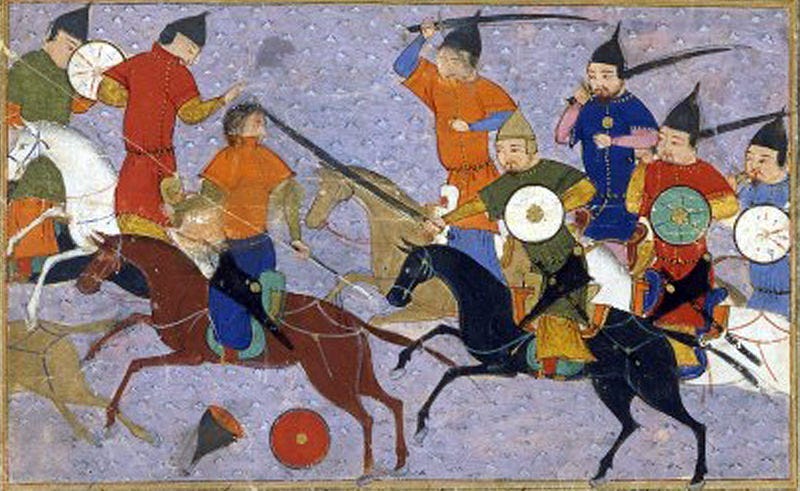

We’ll get to the death toll.
However, first, let’s examine the researchers’ data. Table 1 shows a 33-year overlap between the Mongol invasions and the Black Death. How did Pongratz and her team determine the cause of death during this period? No historical documents show whether someone died from a Mongol raid or the epidemic.
This is a major red flag.
Furthermore, scholars have raised doubts about the death tolls during the Mongol invasions. Historical sources have inconsistencies. According to Juvayni, a Persian historian at the court of Hulagu Khan, Chinggis Khan sacked Herat and slaughtered every citizen. The same historian later says Herat rebelled shortly after the massacre, which had to be subdued.
The two don’t add up.
Who would revolt if everyone were dead?
Historical death estimates also fail to account for the Mongol propaganda machine, which worked around the clock to exaggerate the numbers to ensure the easy capitulation of cities. This is not to deny that the Mongol conquests were horrific—they most certainly were—but they were as violent as any medieval conquest.
We have romanticized ancient and medieval times, envisioning never-ending conflicts. However, back then, conquerors sought to acquire as much territory as possible without engaging in battle.
Chinggis imported paper from Korea to conduct an intense propaganda campaign. He engaged the best writers to describe his atrocities in graphic detail. He’d then send these reports to enemy cities, causing local leaders to surrender without a fight.
Were cities and villages depopulated because of Mongol attacks? Without a doubt.
Was it enough to bring the Earth’s temperature down?
For the sake of argument, if we agree that widespread depopulation significantly reduces carbon emissions, shouldn’t similar destructive conflicts have the same effect? The An-Lushan Rebellion in the 8th century might have wiped out up to one-sixth of the world’s population. However, we have no evidence that it caused a decline in Earth’s temperature.
The theory that Mongol invasions caused the 14th-century Little Ice Age needs to be taken with a large pinch of salt.
Here are the key takeaways from our discussion:
The Mongol invasions didn’t last for 180 years, as claimed by Pongratz. They lasted for 70 years. The dates assumed by the researchers are incorrect.
The invasions lasted for 70 years. According to the researchers’ argument, the estimated duration is insufficient for forests to recover over abandoned farmlands. Hence, carbon dioxide emissions can't be reduced because of the Mongols.
Based on the timelines proposed by the researchers, there is a 33-year overlap between Mongol invasions and the Black Death. During this period, it was impossible to distinguish between those who died from the plague and those who died in a raid.
A conflict-induced population decline does not always lead to a reduction in the Earth’s temperature. There was no global cooling following the An-Lushan rebellion, which may have killed as many people as the First World War.
Historical death tolls are questionable. Critiquing them before using numbers from ancient sources in scientific research is essential.
The myth that Chinggis Khan and the Mongols were eco-friendly conquerors who contributed to global cooling can be laid to rest.
Do you enjoy tales from lost civilizations and cultures from the ancient world and the Middle Ages?
Share this story with your friends and family and subscribe to this newsletter.
If you wish to support the newsletter, consider opting for a paid membership or buying me a coffee!
References
Thomas T. Allsen (2004) Culture and Conquest in Mongol Eurasia, Cambridge Studies in Islamic Civilization Cambridge University Press
John Man (2014) Mongol Empire: Genghis Khan, his heirs, and the founding of modern China.
Peter Jackson (2017) The Mongols and the Islamic World: From Conquest to Conversion, Oxford University Press.
Pongratz et al (2011) Coupled climate-carbon simulations indicate minor global effects of wars and epidemics on atmospheric CO2 between ad 800 and 1850, Holocene.
https://www.theguardian.com/theguardian/2011/jan/26/genghis-khan-eco-warrior
Whenever someone takes a hypothesis and calls it a theory and just runs with it, then a bunch of other people start assuming it's a fact, let's call this event "pulling a Joe Rogan."
I like knowing the facts of a thing but I have to admit the story that Mongols killed enough people that it was noticeable in global temperatures is a really cool story. I imagine that won't go away for a long time.
The incredible story of the extinct birth control plant from the Romans is another cool story. I don't know how true that is, but killing a cool story is harder than spreading it.