
Was Chinggis Khan's Greatest General Obese?
Debunking a popular myth about Subutai, one of history’s finest military minds


One of the most influential books about the Mongol Empire in the 21st century is “Genghis Khan and Making of the Modern World” by Jack Weatherford. The work is a page-turner, not a typical history book, which explains why it became a New York Times bestseller.
In 2022, Weatherford received the Order of Chinggis Khaan, Mongolia’s highest state decoration, for popularizing the history of the Mongols.
Though Weatherford’s book is an excellent introduction to Mongol history, it has some inaccuracies. For example, the text says that Chinggis Khan’s greatest general and one of history’s finest military geniuses, Subutai, was so overweight that he couldn’t ride a horse and “had to be hauled around in an iron chariot.”
According to Weatherford:
One man, however, had a different proposal. Subodei(Subutai), fresh from his victory over the Jurched, had been the greatest general in Genghis Khan’s army, and with his shrewd knowledge of seige warfare and the use of large attack machines, he had played a major role in every important campaign the Mongols fought. He was now sixty years old, probably blind in one eye and according to some reports so fat that he could no longer ride a horse and had to be hauled around in an iron chariot. Despite these physical limitations, his mind sharp and vigorous and he was eager to return to war.
The description of Subutai surprised me. A general famous for feigned retreats and lightning raids couldn’t ride a horse? Mongols traversed harsh terrain with minimal breaks.
Isn’t it cumbersome to carry an overweight commander and slow down the army?
Weatherford doesn’t cite the sources he used to describe Subutai’s physique. I looked up the official Mongol records from the 13th and 14th centuries about Subutai’s life to learn why the author claimed that the Mongol commander was obese and required a medieval equivalent of a mobility scooter to get around.
Interestingly, none of the primary sources describe Subutai's appearance. We don’t know if he was slender, average, ripped, or a bit husky.
So, how did the image of Subutai as a big guy become popular?
Is it because of an incorrect translation?
Or was someone else’s description wrongly attributed to him?
Let’s find out. Before we discuss Subutai’s appearance, let's learn a bit about his early life and military career.
Reminder: By choosing a paid membership (just $5 a month or $50 annually), you're helping amplify voices that history books too often overlook. Your support means these stories get the attention they deserve.
You’ll gain access to tons of members-only content👇
Full-length deep dives into untold stories, like this one: no paywalls, no cuts.
The entire archive of extraordinary tales from the Ice Age to the Fall of the Mongol Empire, the hottest archaeological finds, and the appetizing history of food.
Early access to special editions, be the first to dive in.
Join lively discussions in members-only posts and subscriber chats.
Subutai: Chinggis’ Dog of War

Though Subutai is mentioned frequently in Mongol campaigns, we know little about him as an individual. The two primary sources about Subutai are the Secret History of the Mongols and his biographies in the Yuan Shi (the Book of the Yuan).
He was born in 1175 to the Uriankhai clan, often erroneously called the “forest people” or the “reindeer people.” The Uriankhai are assumed to be ancestors of modern-day Tuvans living in Siberia, giving rise to another myth that Subutai was a non-Mongol who couldn’t ride horses. I’ve encountered this narrative among popular Youtube history channels. But that’s far from the truth.
According to historians Stephen Pow and Jingjing Liao:
“ Perhaps the sense of irony conjured by imagining that the Mongol Empire’s greatest general was a reindeer-herding outsider to steppe nomadic culture has a strong literary appeal to modern authors.”
Official sources say that Subutai was a Mongol whose family had ties to Chinggis Khan’s ancestors for many generations. His father, Jarchigudai, was a blacksmith who supplied Chinggis with food, possibly during the Khan’s flight from Mongolia following a defeat to his rival, and blood brother, Jamukha.
Subutai joined his elder brother Jelme in Chinggis’ service at fourteen and became a devoted follower. As a teenager, he was given the prestigious position of guarding the Khan’s tent.
In 1197, a 22-year-old Subutai got his first major break during a mission against the Merkits. He pretended to be a Mongol deserter and told the enemy that Chinggis’ forces were far away, causing the Merkits to relax, and the Mongols caught them off guard.
Chinggis believed in meritocracy. He saw Subutai’s potential and promoted him to general, putting him in command of four tumens (a tumen had ten thousand soldiers). His rise was rapid, and he became one of Chinggis’ four most trusted commanders, known as the Four Dogs of Temujin, along with Jebe, Jelme, and Khubilai (unrelated to Chinggis’ grandson by the same name).
They are the Four Dogs of Temujin. They have foreheads of brass, their jaws are like scissors, their tongues like piercing awls, their heads are iron, their whipping tails swords . In the day of battle, they devour enemy flesh. Behold, they are now unleashed, and they slobber at the mouth with glee. These four dogs are Jebe, Khubilai, Jelme, and Subutai.
— The Secret History of the Mongols
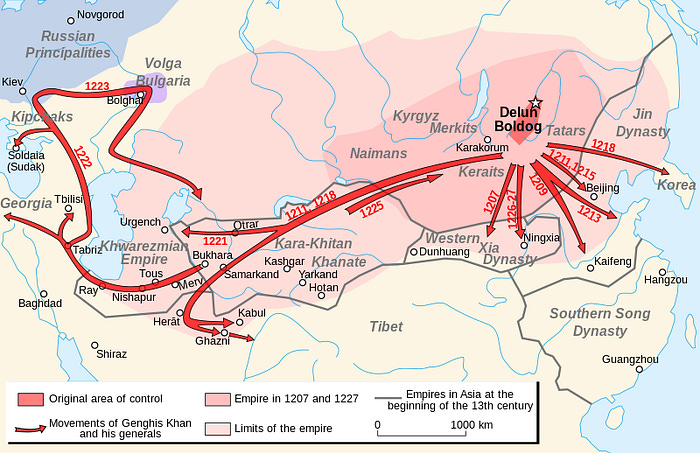
Subutai accompanied Mongol generals Jebe and Mukhulai, during their campaigns against the Jin dynasty in Northern China in 1211 and 1212. He also participated in Chinggis’ 1219 campaign against the Khwarazmian Empire after the Khwarazmian ruler, Shah Mohammad II, executed Mongol ambassadors, inviting the Great Khan’s wrath.
Before the military expedition against the Khwarazmian Empire began, Subutai was ambushed by Mohammed’s soldiers at the Irghiz River in Kazakhstan. Despite being outnumbered three to one, Subutai stopped the enemy's advance.
His opponent’s army size never deterred him.
Keep reading with a 7-day free trial
Subscribe to Forgotten Footprints to keep reading this post and get 7 days of free access to the full post archives.