
Caesar's Forgotten Assassin: The Other Brutus
The story of Decimus Junius Brutus Albinus

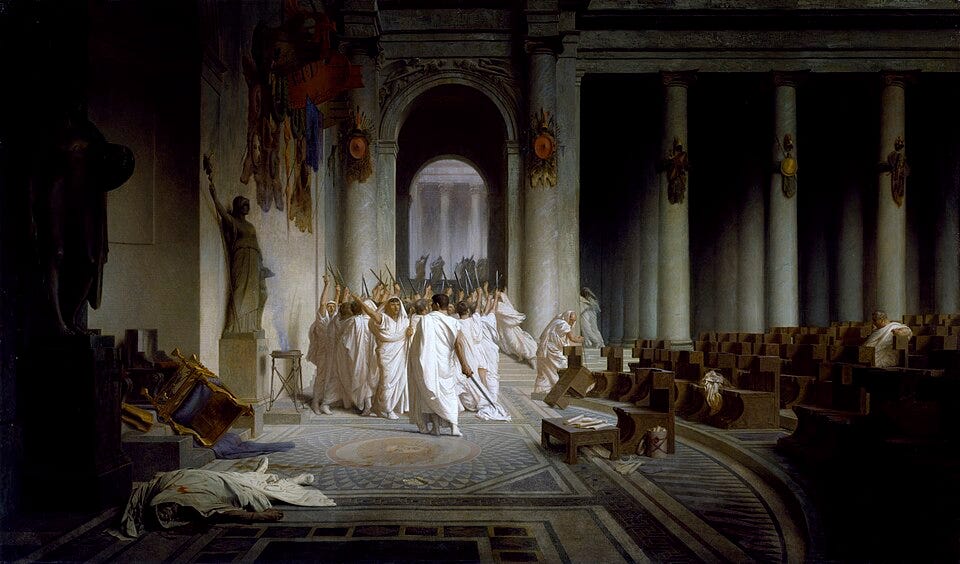
Julius Caesar’s assassination is one of the most discussed incidents in ancient history, intriguing people from diverse walks of life. One of the most well-known among them is playwright William Shakespeare.
The dialogue “Et tu Brute? Then fall Caesar” is immortalized in his play Julius Caesar(1599).
The Roman leader resisted his assailants but gave up when he spotted his close friend Brutus among them. But was Caesar surprised by Brutus’ treachery?
Caesar most likely did not say “Et Tu Brute” since Brutus was not as close to him as Shakespeare imagined. Also, the phrase isn’t mentioned in ancient sources, making it more likely a later-day rendition.
Why did Shakespeare attribute this dialogue to Rome’s most powerful man? What was the rationale behind the expression?
Marcus Junius Brutus, also known as Brutus, was a politician who opposed Caesar during the Roman Civil War. Brutus fervently believed in republican principles and detested the idea of a dictator for life. Thus, it is not surprising that Brutus was Caesar’s assassin.
Shakespeare may have confused Brutus with his distant cousin, Decimus Junius Brutus Albinus, also known as Decimus Brutus, who was one of the assassins of Caesar.
Decimus Brutus was Caesar’s close friend, and they dined together the night before his murder. Caesar must have been stunned by his betrayal, since their bond was like that of a father and son. Shakespeare mentions Decimus Brutus in his play but calls him “Decius.” The playwright overlooked his crucial role in Caesar’s death.
The image of Brutus, as a close friend of Caesar, in the play was likely based on Decimus Brutus rather than Marcus Brutus. Decimus was not a popular and charismatic figure like his cousin. Hence, history has largely forgotten him.
Who was Decimus Brutus, and why did he murder the man who treated him like a son?
Let’s find out.
To avoid ambiguity, I’ll refer to Decimus Junius Brutus Albinus as Decimus and Marcus Junius Brutus as Brutus.
Hi, fellow history buff! This is a preview of our members-only deep dives.
To support my mission and get exclusive content every week, upgrade for just a few dollars per month. You’ll gain access to:
Full-length deep dives into untold stories: no paywalls.
The entire archive of amazing stories from the Ice Age to the Fall of the Mongol Empire, the hottest archaeological finds, and the appetizing history of food.
Early access to special editions.
Join lively discussions in members-only posts and subscriber chats
Starting November 21st, I’m offering you a limited-time 25% off on the annual plans. This discount is available till December 2nd, so if you’ve been thinking about upgrading, now is your best chance!
Who was Decimus Brutus?
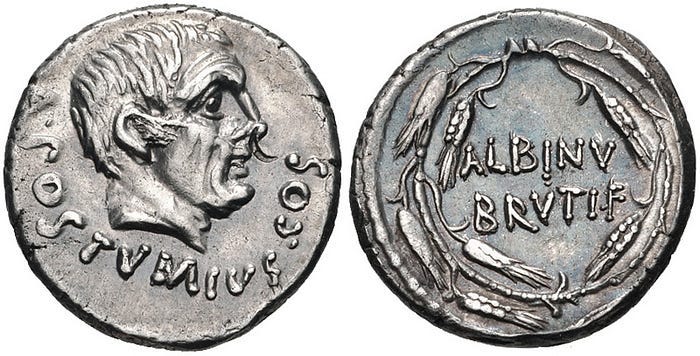
Decimus was born in 81 BC to Sempronia and her husband, Decimus Junius Brutus, a Roman consul. Sempronia was a descendant of Gaius Sempronius Gracchus, one of the Gracchi brothers credited with restructuring Rome’s political and economic institutions.
Decimus was adopted by the Roman patrician Aulus Postumius Albinus, who gave him the surname Albinus.
Because Caesar spoke of his love for Decimus as if he were a son, many people assumed that Decimus was Caesar’s biological child.
According to American historian Ronald Syme, if a “Brutus” was Caesar’s son, it was more likely Decimus than Brutus, who is frequently misidentified as Caesar’s child.
Caesar adored Decimus and named him a secondary heir in his will. If the primary nominee died, Decimus would inherit Caesar’s estate. Adding Decimus to his will prompted Roman historian Appian to believe Caesar had adopted his prodigy.
Decimus was Caesar’s trusted aide during the Gallic Wars (the Roman conquest of modern-day France, Belgium, Luxembourg, Switzerland, and parts of Germany between 58 and 50 BC). He commanded the Roman naval operations.
Decimus led the navy at the Battle of Morbihan in the summer of 56 BC, near present-day Brittany, France, against the Veneti tribe. He won a decisive victory over the Gauls. Morbihan was a crucial battle, as Caesar built on his triumph to set the groundwork for his invasion of Britain.
After Caesar’s tenure as Governor of Gaul expired in 50 BC, the Roman Senate requested that he hand over his territories and return home. Caesar refused to back down. He crossed the Rubicon River in Northern Italy with his army and marched on Rome. The result was the Roman Civil War, often known as Caesar’s Civil War (49-45 BC).
Decimus sided with Caesar’s camp during the conflict. In 49 BC, he led the navy in a heroic capture of Massilia (modern-day Marseille) for the Caesarians. Caesar vanquished his enemies to become Rome’s most powerful man, and Decimus played a critical role in his success.
You may wonder why such a close friend betrayed Caesar. What exactly went wrong? To understand why Decimus turned against Caesar, let’s look at those who wanted the Roman conqueror dead and why.
Keep reading with a 7-day free trial
Subscribe to Forgotten Footprints to keep reading this post and get 7 days of free access to the full post archives.