
Ancient Egypt's Da Vinci
The world’s first known polymath was an architect, a doctor, a writer, and an astronomer


Egypt was suffering from a seven-year drought in the 27th century BC during Pharaoh Djoser’s reign( beginning c. 2670 BC). He approached his vizier with an unexpected request. Djoser wanted to depart from the tradition of his ancestors and be buried in the new necropolis he had built at Saqqara, some 30 km south of present-day Cairo.
The Pharaoh wanted his burial chamber to be inside a majestic pyramid. He thought that his new funerary complex would help lessen his people’s suffering. The project was ambitious, and the vizier’s design would define a new era of engineering in human history.
The vizier was Imhotep, and he is credited with designing Egypt’s first Pyramid, the Step Pyramid of Djoser. He was also the earliest recorded polymath in history, and has been dubbed by some commentators as “Egypt’s Da Vinci.” A man of many talents, Imhotep was a professional scribe, physician, surgeon, astronomer, stonemason, and architect.
He left behind a wealth of knowledge that has benefited generations of engineers and doctors in the Near East and throughout the world. His medical expertise was ground-breaking and well ahead of its time.
Over two thousand years after his death, people declared him a god for his many contributions to Egyptian civilization and the progress of humanity.
On the other hand, some critics suggest there is little evidence of his achievements, and much of it has been posthumously attributed to him. They argue that the cult of Imhotep was born several centuries after his death.
Who was this enigmatic man, and was he really the Da Vinci of Egypt?
Let’s find out!
Hi, fellow history buff! This is a preview of our members-only deep dives.
To support my mission and get exclusive content every week, upgrade for just a few dollars per month.
You’ll gain access to:
Full-length deep dives into untold stories: no paywalls.
The entire archive of amazing stories from the Ice Age to the Fall of the Mongol Empire, the hottest archaeological finds, and the appetizing history of food.
Early access to special editions.
Join lively discussions in members-only posts and subscriber chats.
Designing Egypt’s First Pyramid
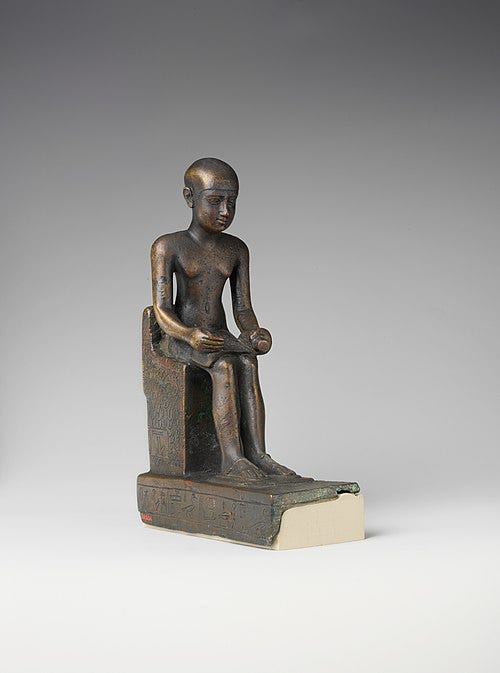
Imhotep came from a humble background. He was born in the village of Gebelein, south of Thebes, the ancient Egyptian capital. We know very little about his early life, except that his father was an architect named Kanofer.
Despite lacking a royal upbringing, Imhotep learned to read and write. He became a scribe and rose through the ranks to become the head priest of the Ra at Heliopolis, a city in Lower Egypt.
Djoser was Egypt’s Pharaoh during Imhotep’s time. He was an ambitious man who did not want to be buried like his ancestors and requested Imhotep to design his new necropolis.
Imhotep was a skilled engineer and architect. He was well-versed in masonry and used his knowledge to build the Step Pyramid of Saqqara, also known as Djoser’s Pyramid. Thus began a tradition of erecting magnificent monuments that became synonymous with the Pharaohs' symbols of power.
There was a key difference between Djoser’s Pyramid and earlier constructions.
